How to Reduce Overwhelm and Prioritize as a New Therapist
Feeling overwhelmed as a new therapist is normal. You are learning clinical skillsets, understanding environmental influences, building caseload operating systems, and managing your own personal well-being while trying to make sense of real client needs all at once. The key is not doing more, but learning how to prioritize what actually matters in session, outside of session, and in your overall personal and professional development.
Why does being a therapist feel so overwhelming at first, and what actually helps?
You are overwhelmed because yo uare lacking structure. Feeling overwhelmed as a therapist often comes from trying to manage too many things at once without knowing how to decide what to do first. You are expected to assess, build relationships, document, and guide treatment, often without being taught how these pieces fit together in real time, and all have their own knowledge, skills, and abilities to develop early on in your career. You need a system.
What kind of structure do I need to be a better therapist?
To reduce overwhelm, you need a way to organize how you think about your work before trying to do more. Structure helps you slow down, identify what matters most, and make clearer decisions in session and in your development.
Several frameworks can help guide this:
Maslow's Hierarchy of Needs helps you understand what a client may need most right now, from basic safety to deeper emotional growth
Bronfenbrenner's Ecological Systems Theory helps you see how a client’s environment, relationships, and larger systems influence their experience
The Eisenhower Matrix helps you prioritize what is most urgent and important in your day to day decisions
Together, these frameworks help you get organized so you can clearly identify what support you need first. From there, you can begin helping your clients do the same.
This way of thinking, not just doing, is what I refer to as navigating your Caseload Ecosystem (Fig. 1.0 below). It is a practical approach to helping early career therapists build clarity, confidence, and consistency in their work so they can grow as clinicians while still enjoying their lives outside of therapy.
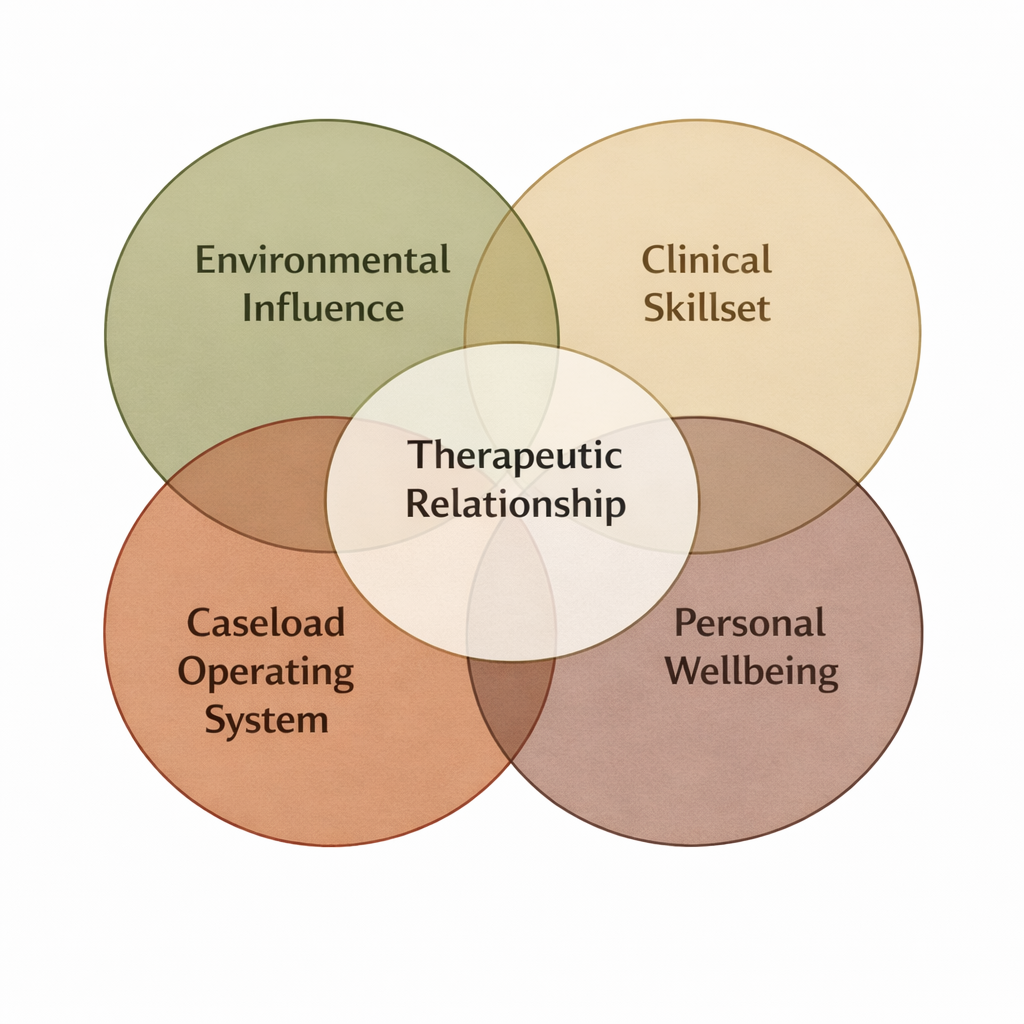
Fig. 1.0. Caseload Ecosystem
What resources help new therapists improve faster?
The most helpful resources for new therapists are not just theories or modalities, but tools that help you organize your learning and guide your actions in session and in supervision. When you have structure, it becomes easier to focus on what matters first and foremost, and then improve with intention.
This includes:
Frameworks for structuring intake and early sessions, such as the Case Compass (a free guide provided by The First Caseload) and the First Four Arc, a step by step checklist for guiding your client through the first four sessions with clarity and direction
Systems for managing your caseload week to week, like the Focus Hour and Monthly Alignment Checks found within the Caseload Operating System, which help you stay organized and consistent in your work
Tools that support reflection and growth, such as the Learning and Development Plan and Client Roster within the Caseload Operating System, which help you track patterns, adjust your approach, and continue developing over time
These tools are designed to work together, not in isolation, giving you a system for navigating your development as a therapist from your first session onward so you learn right alongside your clients.
Who should I rely on as a new therapist?
New therapists grow fastest when they are supported by both people and systems. Clinical supervision, consultation groups, and peer support all help, but they are most effective when you come in with structure and specific questions about your work.
This includes:
Ongoing consultation and community support, such as The First Caseload Membership, which offers monthly consultation groups and a growing library of learning videos, including role played intakes and high stake clinical moments to help you see what this work looks like in real time
Individualized guidance and skill development, such as Caseload Coaching with Tyler, which helps you make better use of your clinical supervision, strengthen your Learning and Development Plan, and tailor your Caseload Operating System to your role, your setting, and your long term career goals
Clinical supervision and peer relationships, which provide space for feedback, reflection, and support as you continue to build confidence and refine your approach
The goal is not just to have support, but to have the right support that actually helps you grow.
How can I tell if therapy is actually working for my clients?
Therapy is working when there are small, but consistent, observable signs of movement in your client’s day to day, over time. Most progress shows up in patterns, not one moment.
Look for:
Consistent attendance
Clients return because something feels helpful or importantActive participation
Clients engage in sessions instead of staying surface-levelFollow-through outside of session
Clients begin applying insights or skills in their daily lifeMovement toward goals
Even small steps toward what they said they wanted
When you learn to track progress through patterns like these, you reduce the noise of anxiety and imposter syndrome, giving yourself the clarity needed to prioritize your work and show up with greater confidence in each session. Learning how to be a therapist is not about knowing everything, it is about learning how to think, prioritize, and stay grounded in the middle of complexity. When you have a clear way to organize your work, your growth becomes more intentional and your sessions become more focused. Over time, what once felt overwhelming starts to feel manageable, and then eventually, meaningful. This is the work of building your Caseload Ecosystem, not perfectly, but consistently, so you can show up for your clients with clarity while also building a career and life that feels sustainable.
References
Bronfenbrenner, Urie, U., & Morris, Pamela A., P. A. (2006). The bioecological model of human development. In R. M. Lerner (Ed.), Handbook of child psychology (6th ed., Vol. 1, pp. 793–828). Wiley.
Covey, Stephen R., S. R. (1989). The 7 habits of highly effective people. Free Press.
Maslow, Abraham H., A. H. (1943). A theory of human motivation. Psychological Review, 50(4), 370–396.https://doi.org/10.1037/h0054346
Tyler Keith (2026). Caseload Operating System. The First Caseload. https://thefirstcaseload.com